Why a driveway is not always a parking pad
· 3 min · CampsiteFit
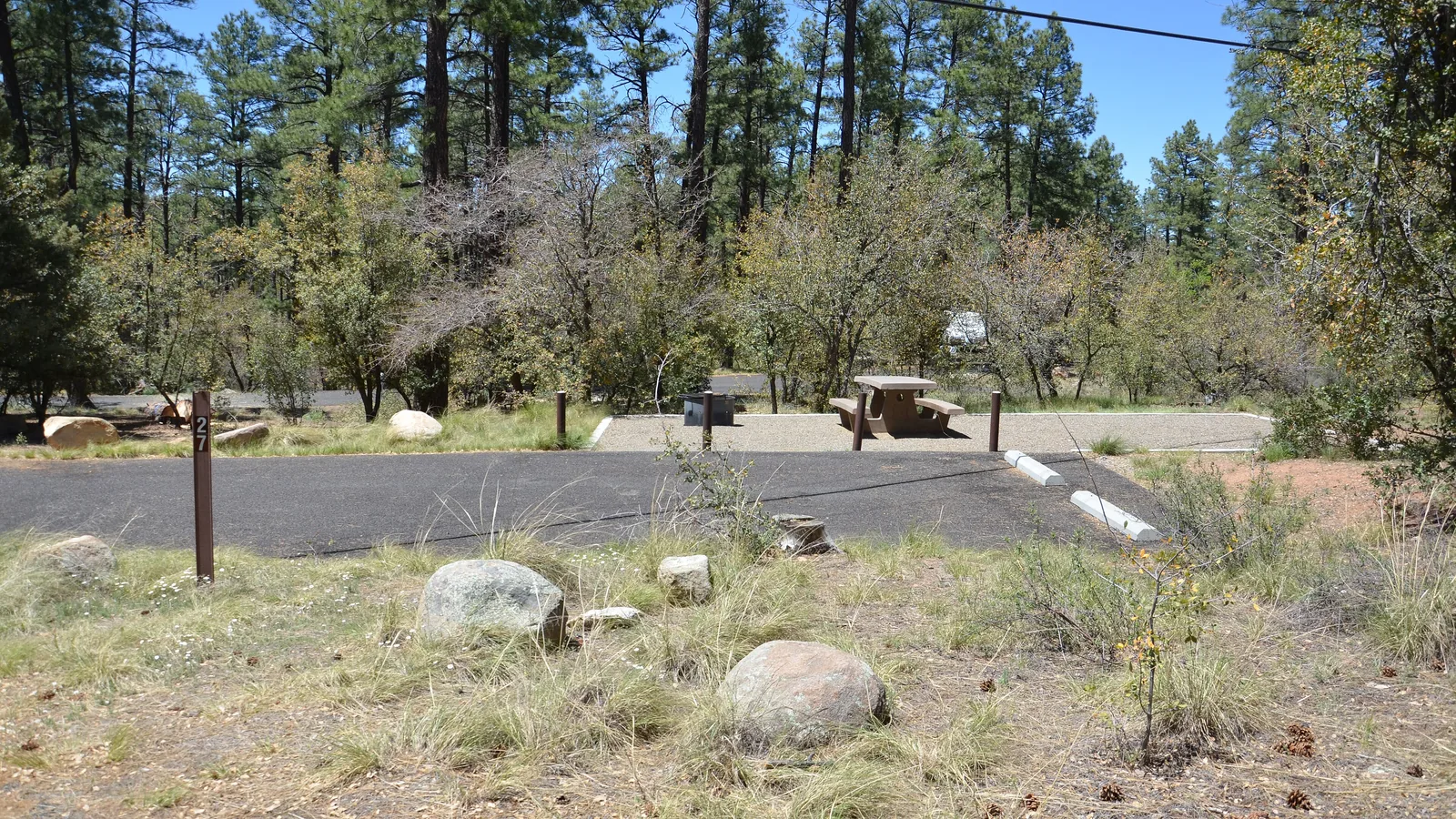
Most campsites tell you directly how long a rig they take. Some do not, and for those there is a fallback: the driveway. It is the weakest evidence this site uses, it answers 3% of the questions, and every serious mistake in the corpus has come from it.
Where an answer actually comes from
Across every bookable federal campsite:
| the answer comes from | sites | share |
|---|---|---|
| the permitted-equipment limit for your rig class | 68,606 | 59.4% |
| a general maximum vehicle length | 13,536 | 11.7% |
| the driveway | 5,364 | 4.6% |
| nothing — no length published | 27,975 | 24.2% |
Six answers in ten come from the source stating a limit for the class of rig you actually own. That is the good case, and it is still most of the corpus — though a smaller majority than it was, because widening the corpus in August 2026 brought in campgrounds that publish less, and a quarter of all bookable sites now publish no length at all.
The 19.5% that publish nothing are shown as unknown. They are never counted as fitting and never counted as not fitting, because absence is not a measurement.
The 3% is where it goes wrong
A driveway length is a measurement of ground. Whether it is your ground depends on what kind of site it is, and the source does not say so directly.
- At a cabin, lookout or ranger station, the "driveway" is frequently the access track you walk in from. One cabin published 900 ft.
- At a group area, it is ground for many vehicles at once. One published 2,640 ft, half a mile, and an earlier version of this site read it as a rig limit.
- At a walk-in site, it is the car park you leave from.
- And where one value repeats across every site in a property, it is the property's figure and not any particular site's measurement.
That last one is the subtle case, and it is not rare. 59 properties publish the same driveway length on every site they have, covering 1,057 campsites between them. Indian Scotty published 200 ft on all 28 of its records, two of them WALK TO, with nothing else per-site to corroborate it. One number standing in for a whole campground, which is this site's entire thesis arriving in its own data.
The other 26 are the same shape. Live Oak South in California publishes 10 ft on all 90 of its sites, Dripping Springs Campground 25 ft on all 33, Kimball Bend Park in Texas 45 ft on all 36, and Beard's Bluff Park in Arkansas 85 ft on all 22. One figure entered once for a whole property, with no per-site measurement anywhere behind it.
Magnitude is not the test
The obvious guard is a plausibility range: reject anything longer than a rig could be. It does not work.
A cabin with a 40 ft access track is exactly the same mistake as a cabin with a 900 ft one, and it sits comfortably inside any threshold worth setting. The question is never how long is this number but what is it measuring.
So a driveway becomes a rig limit only where two things hold. The site has to be an ordinary campsite rather than a structure, a group area or a walk-in, and the value has to be that site's own rather than a figure repeated across the property.
What this costs
Both rules remove real answers. Sites that would have shown a number now show "not published", and a campground that looked like it had a long site sometimes turns out to have no measured site at all. The same trade removes every tent-only and horse-only site from the length answers as well.
That is the trade this site makes everywhere, and it restates plainly as a wrong number is worse than no number. Someone who sees "not published" goes and checks. Someone who sees "40 ft" books.
The four rows in the table are recomputed from the Recreation Information Database on every load, and each campground page links to the record behind its own numbers. How it is measured sets out the fallback order in full.