Where a 38 ft fifth wheel actually fits
· updated · 7 min · CampsiteFit
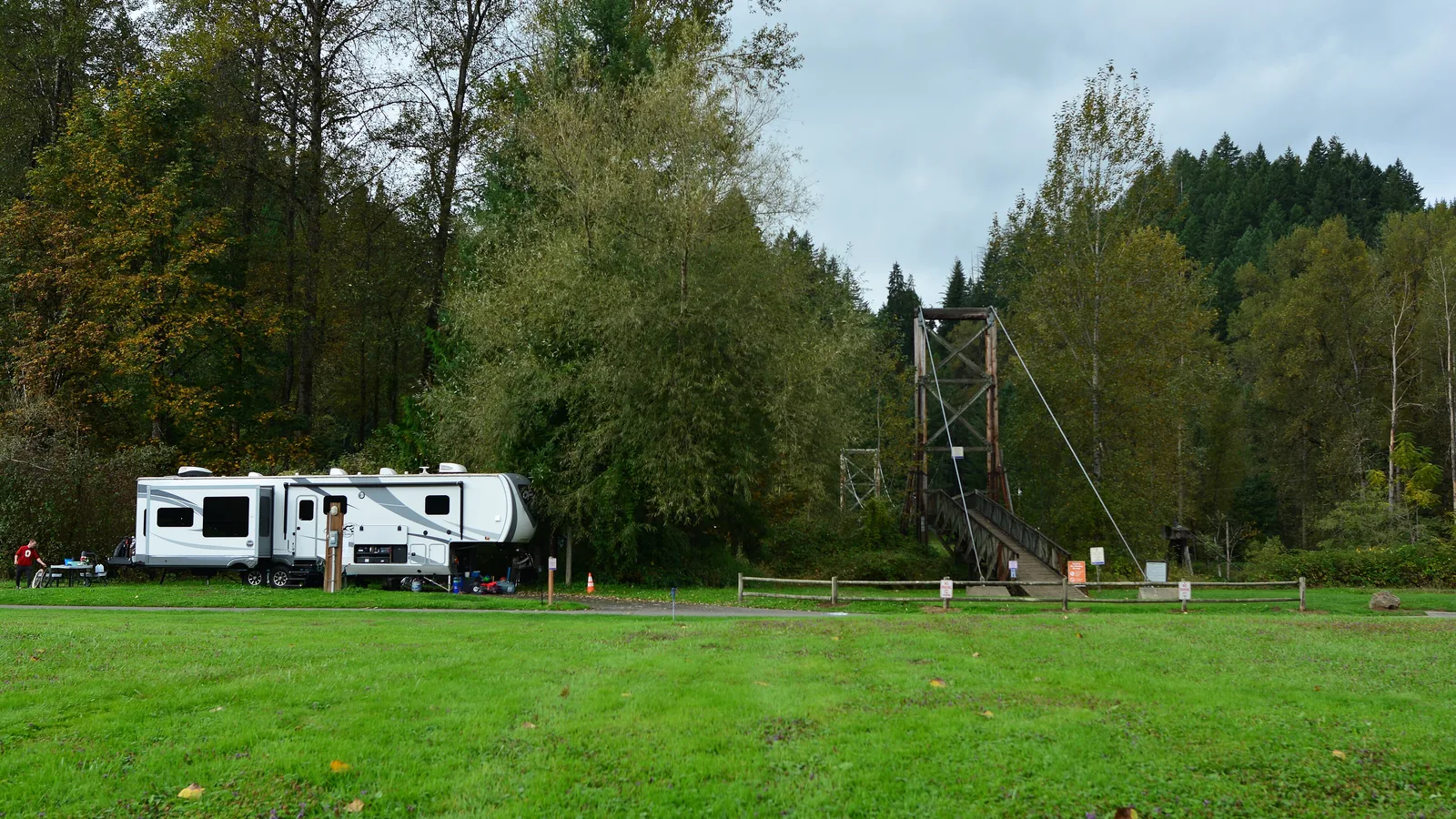
A 38 ft fifth wheel is an ordinary rig, longer than a van and shorter than a 45 ft toy hauler. It sits in the middle of what people tow, which makes it a useful probe: run it against every bookable federal campsite in the country and the map separates sharply.
From nothing to nine tenths
Every state below has at least sixty bookable federal campsites, so a two-site campground cannot produce a 100% or a 0% out of nowhere. Within that, the share of sites taking a 38 ft fifth wheel runs from 89.6% in Iowa to nothing at all in Maine.
| State | Campgrounds | Sites taking 38 ft | Share |
|---|---|---|---|
| Iowa | 21 | 1,687 | 89.6% |
| Illinois | 17 | 1,386 | 84.4% |
| Ohio | 4 | 322 | 84.3% |
| Kansas | 41 | 2,075 | 81.4% |
| Alabama | 20 | 1,088 | 79.5% |
| Mississippi | 30 | 1,276 | 78.6% |
| Louisiana | 12 | 65 | 69.9% |
| Texas | 89 | 3,234 | 69.4% |
| Kentucky | 34 | 1,831 | 68.2% |
| Nebraska | 7 | 191 | 67.7% |
| Oklahoma | 74 | 2,988 | 65.2% |
| South Dakota | 22 | 483 | 65.1% |
| Missouri | 59 | 2,481 | 64.5% |
| Pennsylvania | 28 | 1,198 | 61.8% |
| Arkansas | 112 | 3,385 | 60.9% |
| West Virginia | 22 | 913 | 60.7% |
| Minnesota | 42 | 795 | 53.1% |
| South Carolina | 15 | 314 | 52.1% |
| North Dakota | 14 | 335 | 51.5% |
| Idaho | 157 | 1,275 | 48.3% |
| Wisconsin | 40 | 662 | 47.5% |
| Vermont | 6 | 97 | 44.9% |
| Tennessee | 51 | 1,123 | 44.3% |
| Michigan | 75 | 727 | 43.3% |
| Georgia | 43 | 887 | 42.0% |
| Wyoming | 76 | 1,125 | 40.7% |
| Florida | 25 | 449 | 38.7% |
| Utah | 236 | 2,322 | 38.6% |
| North Carolina | 43 | 979 | 37.3% |
| Alaska | 56 | 285 | 36.0% |
| Nevada | 21 | 347 | 35.0% |
| Montana | 94 | 1,103 | 34.9% |
| Arizona | 76 | 1,065 | 30.4% |
| Washington | 130 | 1,368 | 29.7% |
| Oregon | 262 | 2,367 | 29.3% |
| Colorado | 251 | 1,728 | 27.8% |
| New Mexico | 41 | 283 | 26.1% |
| California | 438 | 3,928 | 22.3% |
| Indiana | 11 | 101 | 21.4% |
| Virginia | 49 | 477 | 19.5% |
| Maryland | 8 | 80 | 18.9% |
| New Hampshire | 15 | 55 | 10.1% |
| Maine | 6 | 0 | 0.0% |
Maine is the line worth pausing on. Six federal campgrounds, 60-odd bookable sites between them, and not one takes a 38 ft fifth wheel. That is not a low share. It is a state where this rig has nowhere federal to go.
Vermont held that position until August 2026, on three campgrounds and sixty sites. Widening the corpus found three more Vermont campgrounds and moved it to 44.9% — which is the honest hazard of a rate computed over a small denominator, and the reason this table states its floor of sixty bookable sites rather than ranking everything.
Count, not share, is what you book
The share tells you your odds at a campground you have not chosen yet. The count tells you how much choice you have, and the two point different ways.
California sits near the bottom on share, at 22.3%, and still offers 3,928 sites that take a 38 ft fifth wheel, more than any other state and more than Iowa and Illinois combined. A low share across a large corpus still leaves plenty of options, and finding them is the work.
Which is the whole problem with browsing by campground. At 22% you will open listing after listing where the answer is no, and the ones where the answer is yes look identical from the outside.
Who built it predicts more than where it is
The obvious explanation for the table above is regional, and it is wrong. Sort the same sites by the agency that operates them instead:
| Operator | Campgrounds | Sites taking 38 ft | Share |
|---|---|---|---|
| Army Corps of Engineers | 554 | 26,254 | 70.1% |
| Forest Service | 1,951 | 18,361 | 35.4% |
| Bureau of Land Management | 114 | 836 | 29.6% |
| Bureau of Reclamation | 9 | 165 | 23.4% |
| National Park Service | 247 | 3,204 | 17.0% |
Read the first two columns together and the point sharpens: the Corps runs under a third as many campgrounds as the Forest Service and offers 43% more long sites. 554 against 1,951, and 26,254 against 18,361.
Corps campgrounds are reservoir campgrounds, laid out around flood-control lakes on ground that was graded when the dam was built. Park Service campgrounds are frequently older, tighter, and inside boundaries that cannot be regraded.
That single fact carries most of the state table. Iowa, Illinois, Kansas, Alabama, Mississippi, Texas, Kentucky. The top of the list is Corps reservoir country almost without exception, and Wyoming, Arizona, Utah, Colorado, Nevada and Michigan have no Corps campgrounds in this corpus at all.
It does not carry all of it. Idaho is 4% Corps and still reaches 48.3%, ahead of Tennessee and Georgia, which have far more of it: a Forest Service state performing like a Corps one. Where the land was flat and the layout is recent, Forest Service campgrounds are as generous as anyone's. State still matters. Operator matters more.
The same reversal shows up inside a single campground, where a pull-through turns out to beat a back-in almost everywhere except at the Corps.
The most room in the country
Share is your odds at a campground you have not chosen. Count is how much choice you have once you are there, and these are the campgrounds where a 38 ft fifth wheel has the most of it:
| Campground | State | Sites taking 38 ft |
|---|---|---|
| Bloomington East | Kansas | 299 of 305 |
| Shenango Rec Area | Pennsylvania | 298 of 304 |
| Mill Creek, Berlin Lake | Ohio | 255 of 296 |
| Prairie Flower Recreation Area | Iowa | 243 of 252 |
| Sugar Bottom | Iowa | 219 of 220 |
| Strawberry Bay | Utah | 201 of 227 |
| Cape Point | North Carolina | 198 of 200 |
Five of the seven are Corps reservoir campgrounds, which is the operator argument arriving one campground at a time. Cape Point is the exception worth knowing: it sits on Cape Hatteras National Seashore under the Park Service, the agency with the lowest share in the country, and 198 of its 200 sites take the rig anyway.
What to do with it
- Filter by your rig before you browse rather than after. Every listing here answers for the class you picked, because a fifth wheel and a motorhome get different published limits on 5,872 bookable sites.
- Read the count as well as the share. A state with a low share and a large corpus may still be your best option.
- If the share matters more than the scenery, look at who runs it. The operator is on every campground page here.
- Treat "not published" as not published. A site that publishes no length is never counted as fitting here, and there are enough of them that guessing would change every number above. The advertised campground maximum is a worse guess still.
Both tables come from the Recreation Information Database, which is public domain, and every state row can be reopened on that state's page. The rule that decides whether a site counts is on how it is measured.
Updated 14 August 2026: the corpus now covers every state with federal campgrounds (49 of them, Delaware having none) and every figure here was recomputed against it. An earlier version proposed that the western states led because their sites were laid out latest. The national picture does not support that, and the operator breakdown above replaces it.